Flourishing Starts With People
This week I had the opportunity to join leaders from across the country at the Federal Reserve Bank of Atlanta for the Flourishing Neighborhoods Conference, hosted in partnership with Georgia Tech’s Center for Urban Research.
I was honored to join the “Visions for Flourishing Neighborhoods” panel alongside Courtney English from the City of Atlanta, Jonathan Ippel of Amplify GR, and James Fritze of NewTown Macon, with Monica Evans facilitating the conversation.
We talked about neighborhood revitalization, economic mobility, trust, and what it actually takes to create communities where children and families can thrive. And throughout the conversation, I kept coming back to one thing:
This work starts with people.
Not assumptions.
Not top down solutions.
People.
The lived experiences of residents should shape the work. Our job is to listen, build trust, respond, and help create the conditions for communities to flourish.
What was beautiful is that the conversation did not stay in Atlanta. I came home and watched it unfold in real time throughout Birmingham, and specifically in Woodlawn.
The very next day, we hosted Women’s Empowerment: Her Hour in partnership with Girls Girls. And honestly, the event felt less like a program and more like a reminder.
A reminder that Woodlawn has always been rooted in strong matriarchal leadership.
Women in this community have carried families, blocks, churches, schools, and neighborhoods for generations. They have held things together when resources were limited. They have stretched, sacrificed, nurtured, organized, and led often without recognition.
Her Hour created space for women to pour back into themselves while also pouring into one another. It was about wellness, connection, entrepreneurship, leadership, and community. It was about reminding women that they deserve to be supported too.
Because when women are supported, communities are supported.
And this week, I kept seeing that truth over and over again.
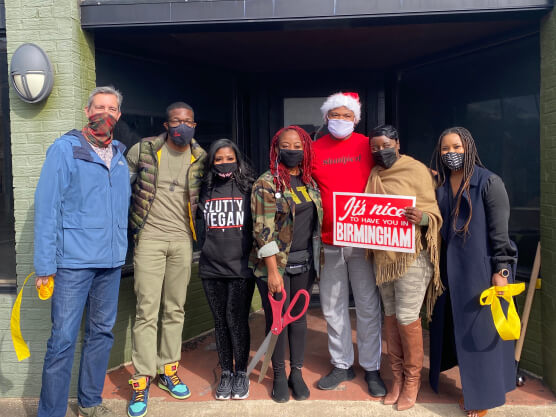
I watched Selena open her business while raising a daughter connected to i3 Academy and other community programs shaping the next generation. At the ribbon cutting, her daughter Allison had a pop up gelato stand, and I immediately thought, “We need an ice cream shop in Woodlawn.”
Not just because of the ice cream.
Because of what it represents.
Walkability.
Connection.
Families gathering.
Kids laughing.
Neighbors running into each other.
Community.
I looked at Allison and thought, “Now I’ve got to find you a building.”
That moment stayed with me because it represented something bigger than a small business idea. It represented belief. Ownership. Possibility. It represented a young girl seeing herself as someone who could create something in her own neighborhood.
And then today, I left another closing table.
Cinnamon, another dynamic woman in our community, purchased her first home.
As we sat waiting for the final documents to process, her dad looked around the table and said something simple but powerful:
“I’ve just got to acknowledge all these women at the table.”
And he was right.
Besides him, the table was filled with women.
Women helping guide the process.
Women building wealth.
Women supporting one another.
Women creating stability for their families and future generations.
In that moment, I started reflecting on the entire week.
The panel at the Federal Reserve Bank of Atlanta.
Her Hour.
Women opening businesses.
Women mentoring daughters.
Women buying homes.
Women building community.
There is something intentional happening right now.
There is a dynamism among women in this city that feels impossible to ignore.
Not performative.
Not transactional.
Transformational.
Women are not just participating in the growth happening in Birmingham. In many ways, they are helping shape it.
And what excites me most is that this momentum is happening in community. People are supporting one another. Sharing resources. Showing up for each other’s businesses. Creating spaces where people feel seen and connected.
That is what flourishing neighborhoods look like.
Not just buildings.
Not just development.
Not just investment.
But relationships.
Trust.
Ownership.
Belonging.
Vision.
The energy is here. The momentum is here. Now we have to match it with long term investment and intentionality.
We cannot keep doing surface level work. We have to bring real capital into communities, trust residents and business owners, and build alongside the people who have been holding neighborhoods together all along.
Birmingham still has an opportunity to grow intentionally. To grow in a way where existing residents and new residents can thrive together.
Neighborhoods are the units of change.
And flourishing takes trust, vision, investment, and people willing to believe in what is possible.
This week reminded me that the people already doing the work in our communities are often the blueprint.
Especially the women.